Sharing a bed means finding a mattress that works for two people. One partner may turn frequently, while the other wakes easily. You might also prefer different firmness levels or need more space to stretch out.
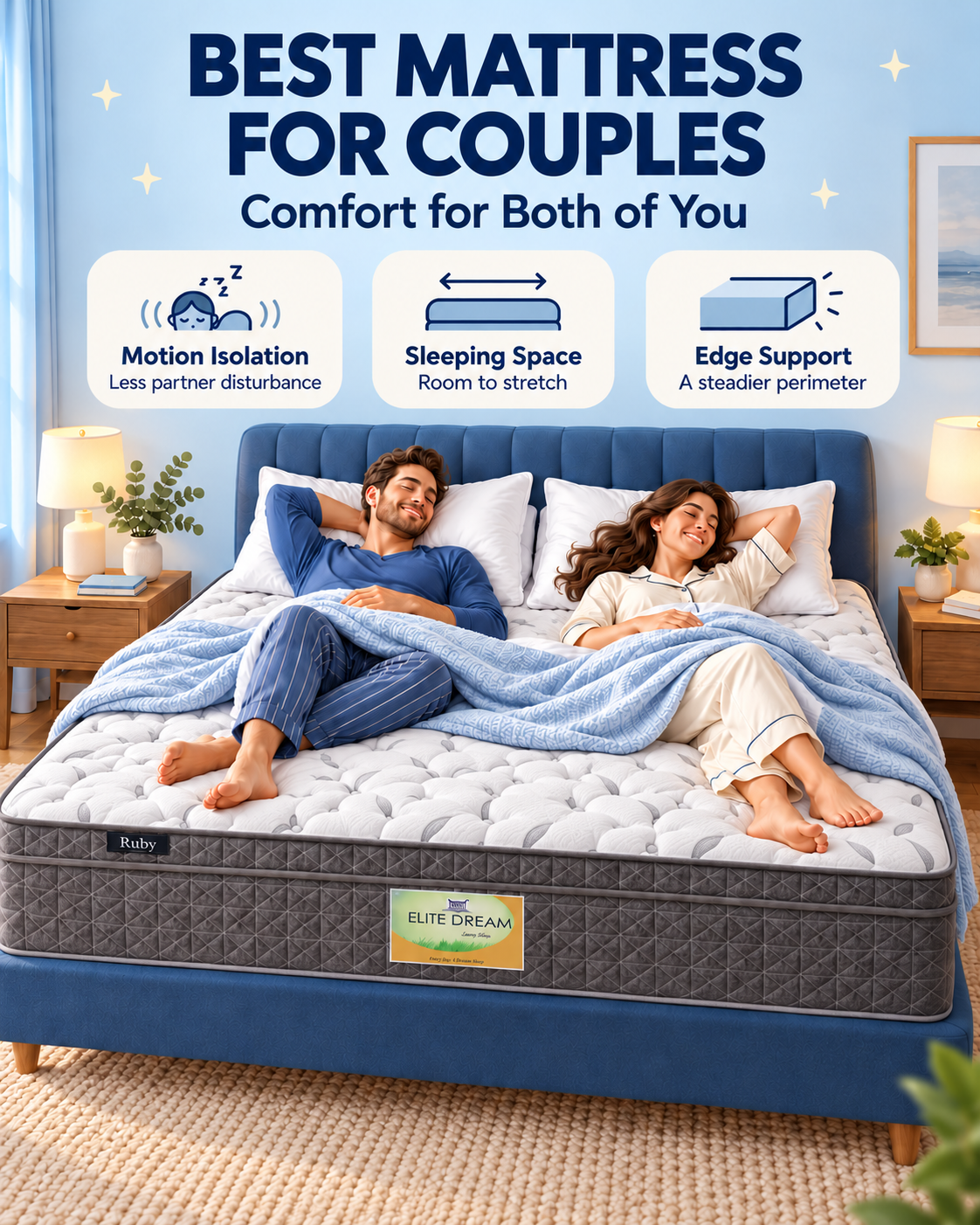
When choosing the best mattress for couples in the UAE, start with three features: motion isolation, sleeping space and edge support. Together with a comfortable firmness level, these can help you find a bed that suits both partners.
This guide explains what to look for and introduces three Ruby options to compare: Elite Dream, Emotive and Royale.
What Should Couples Look for in a Mattress?
| Feature | Why It Matters | What to Check |
|---|---|---|
| Motion isolation | Helps limit movement travelling between partners | How much movement you notice when your partner turns or gets up |
| Sleeping space | Gives each person room to settle and change position | The actual mattress width and length in centimetres |
| Edge support | Helps the perimeter feel more stable | Comfort when lying near the side and sitting on the edge |
| Firmness | Affects how comfortably each partner settles into the surface | Both partners' preferences and sleeping positions |
| Responsiveness | Affects how easily you can turn over | Whether the surface feels comfortable to move on |
1. Motion Isolation: Reduce Partner Disturbance
Motion isolation describes how well a mattress limits movement travelling across its surface. It is particularly relevant if one partner changes position frequently or gets into bed later than the other.
Memory foam can absorb movement, while individually wrapped pocket springs respond separately to pressure. A mattress combining these materials may offer cushioning alongside responsive support.
However, the complete construction matters. Comfort layers, spring design and the bed base can influence what you feel. No mattress can guarantee that you will never notice your partner moving.
How to Test Motion Isolation
Lie on the mattress together. Ask one partner to turn over, sit up and carefully get out of bed while the other stays still. Compare the sensation across your shortlisted models rather than relying only on a product label.
2. Sleeping Space: Compare Width Before Size Names
Even a comfortable mattress can feel restrictive if two people do not have enough space. A wider sleeping surface gives each partner more room to change position.
Use the exact measurements when comparing sizes. Names such as queen, king and super king can refer to different dimensions between brands and regional sizing systems.
| Mattress Dimensions | Width per Person |
|---|---|
| 150 × 200 cm | 75 cm |
| 160 × 200 cm | 80 cm |
| 180 × 200 cm | 90 cm |
| 200 × 200 cm | 100 cm |
These figures divide the mattress width equally; they do not account for how close to the edge each person feels comfortable sleeping. Confirm available dimensions on your chosen product page.
Before upgrading, measure the bed frame and room. Include space for walking, opening wardrobes and using bedside furniture. Check the delivery route through doors, lifts and stairs too.
3. Edge Support: Make More of Your Sleeping Surface
Edge support describes how stable the mattress perimeter feels under pressure. For couples, it matters because one or both partners may sleep closer to the side.
A stable edge can make the perimeter feel more usable. It can also help when sitting on the side to put on shoes or get into bed. Some mattresses use foam encasement or other perimeter reinforcement.
Test both sitting and lying near the edge. These place different loads on the mattress, so a comfortable sleeping edge may still compress noticeably when you sit on it.
Three Ruby Mattresses to Compare for Couples
Elite Dream Euro Top Mattress
The Elite Dream Euro Top Mattress combines individual pocket springs with a Euro-top comfort section and foam cushioning. Ruby's listing describes foam-encased edge reinforcement.
Include Elite Dream in your comparison if you want to assess pocket spring responsiveness alongside perimeter stability. Test its surface feel together and confirm the current firmness description before ordering.
Emotive Pocket Spring Mattress
The Emotive Pocket Spring Mattress lists a medium feel, a deeply quilted Euro top and a 30 cm thickness. Its independent pocket spring unit includes foam encasement, described by Ruby as supporting motion isolation and edge stability.
It is an option to compare when both partners want a medium comfort level with a cushioned finish. Assess how easily you can turn and how comfortable the edges feel.
Royale Memory Foam Mattress
The Royale Memory Foam Mattress combines memory foam, high-density foam and individually wrapped pocket springs. Ruby describes it as having a soft feel.
Despite its name, Royale is a foam-and-spring hybrid rather than an all-foam mattress. Consider it if you both enjoy softer cushioning. Ask about its current edge construction and test the perimeter if edge stability is a priority.
Which Option Should You Try First?
- For a medium feel: Start by trying Emotive, then compare it with your other shortlisted options.
- For softer memory foam cushioning: Include Royale.
- For Euro-top comfort with listed edge reinforcement: Compare Elite Dream and Emotive.
These are starting points based on the listed construction, rather than a ranking of tested performance. The best choice depends on how each mattress feels to both of you.
What If You Prefer Different Firmness Levels?
Begin by identifying what each partner dislikes about the current mattress. “Too firm” may mean pressure around the shoulders, while “too soft” may mean excessive sinking or difficulty turning. Specific descriptions make comparison easier.
Try a range of comfort levels together. A medium mattress may be worth exploring, but it will not suit every couple. Differences in body weight can also make the same mattress feel different to each person.
If your preferences remain far apart, ask whether separate mattresses on a compatible shared base are practical. Confirm dimensions, heights, base requirements and availability before choosing this arrangement.
A Couple's Mattress Shopping Checklist
- Measure your bed: Record the internal width and length in centimetres.
- Agree on priorities: Decide whether movement, space, firmness or edge stability matters most.
- Test together: Lie in your normal sleeping positions and allow time to settle.
- Check movement: Take turns rolling over and getting out of bed.
- Try the edges: Assess both lying and sitting.
- Review purchase terms: Confirm the selected-size price, delivery, warranty and return conditions.
Frequently Asked Questions
Is memory foam or pocket spring better for couples?
Both can be worth considering. Memory foam can absorb movement, while independent pocket springs provide responsive support. Hybrid mattresses combine these materials. Compare the complete mattress rather than choosing by material name alone.
Does a bigger mattress stop motion transfer?
A bigger mattress creates more space between sleepers, but size alone does not determine motion isolation. The mattress construction and bed base also matter.
Why does my partner find the same mattress softer than I do?
Body weight, sleeping position and personal preference affect perceived firmness. One partner may compress the layers more deeply and experience a softer feel.
Does edge support mean the side will not compress?
No. Some compression is normal. Edge reinforcement aims to improve perimeter stability, but the sensation varies with construction and the pressure applied.
Find a Mattress That Works for Both of You
Choosing a shared mattress starts with understanding both partners' needs. Compare movement isolation, actual sleeping space, edge stability and comfort before deciding.
Explore Elite Dream, Emotive and Royale, or contact Ruby Mattresses with your bed dimensions and both partners' comfort preferences for help narrowing down your options.